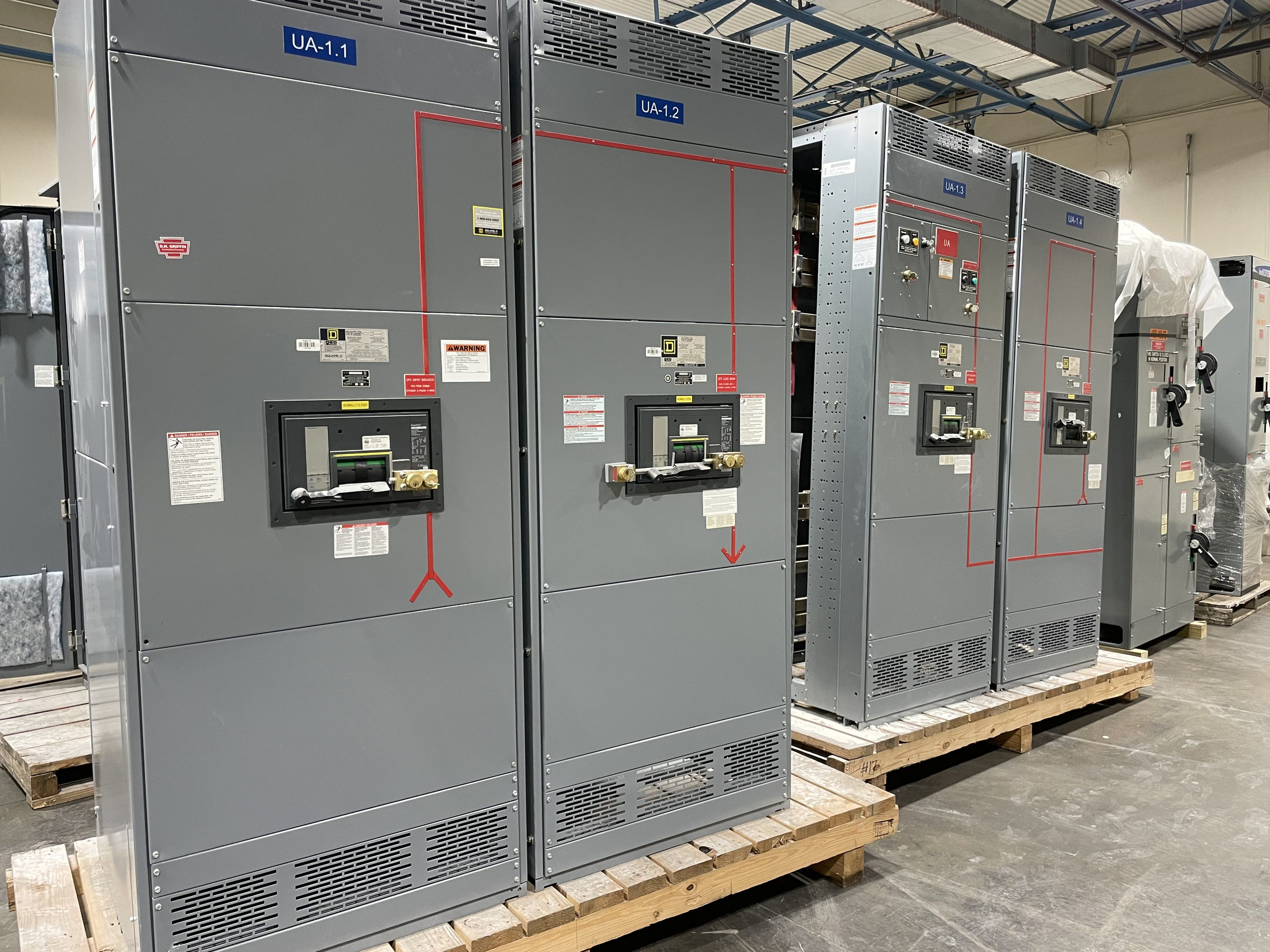
A Manufacturer Focused on New Switchgear
We manufacture and supply new switchgear for customers in Austin and throughout Central Texas. This page introduces how we approach that work: by starting with the project’s electrical requirements, operating conditions, and schedule rather than assuming one standard assembly fits every application. Our equipment is built in the USA using all-American components, and custom assemblies can be developed to specification. We can also ship nationwide. Whether a project involves a new facility, an expansion, or planned equipment replacement, the first useful step is to define what the electrical system must accomplish and what constraints the equipment must meet.
A manufacturer’s role is to turn documented requirements into equipment choices that can be reviewed by the project team. We work from the information provided, identify decisions that need confirmation, and keep the discussion centered on fit, ratings, configuration, and coordination. Lead times are determined by the project; they should be discussed against the actual scope and required design approvals, not treated as a universal promise.
Start With the Application and System Requirements
The right switchgear depends on its place in the electrical system. A project team should establish whether the equipment is intended for service entrance, distribution, source transfer, or another defined function, and identify the loads and operating sequence it must support. The available system voltage, continuous current requirements, fault-current conditions, and protection approach all affect equipment selection. These values must come from project documents and qualified electrical professionals; no rating should be assumed suitable based on a product category or a general description of the site.
The application also shapes practical design questions. Indoor or outdoor placement, available room, cable entry and exit, access for operation and maintenance, and connection to upstream and downstream equipment may constrain the assembly. Confirming these conditions early helps avoid a design that meets an isolated electrical requirement but conflicts with the building layout or system interfaces. Relevant authorities and the project’s electrical professionals must review the design and applicable requirements.
Select Equipment Against Verified Technical Criteria
Switchgear and switchboards are not interchangeable labels for a single universal product. Equipment type, construction, interrupting or withstand capability, protective devices, and applicable standards depend on the intended use and system design. The project specification should identify the required function and ratings, while the electrical engineer verifies that those requirements align with available fault-current information, conductor details, protective-device coordination, and the governing codes or standards. Ratings and enclosure choices require project-specific review; a value appropriate for one installation may not be acceptable for another.
UL 891 applies to suitable switchboard assemblies, where relevant; it does not automatically apply to every switchgear product or to medium- or high-voltage equipment. Applicable standards and any required listing must be confirmed for the specific design. We can discuss UL 891 assemblies when the application is appropriate, but the project team should verify the requested construction, standard, and approval requirements before design decisions are finalized.
Shape a Custom Assembly Around the Project
Custom design choices are most useful when they resolve documented project needs. Depending on the scope, the team may need to define the arrangement of incoming and outgoing circuits, protective-device functions, metering, control interfaces, internal separation, or provisions for future connections. Physical dimensions and access also matter: room clearances, routing paths, cable bending space, conduit locations, and the means of moving equipment into position should be reviewed against current drawings and site constraints. None of these details should be inferred from a city or building type alone.
A clear specification helps distinguish mandatory requirements from preferences and open questions. Provide one-line diagrams, equipment schedules, load and fault-current data, control requirements, and interface information where available. If documents conflict or omit a decision that affects design, resolve it with the responsible engineer and relevant authorities. That review gives the manufacturer a sound basis for developing an assembly to specification and gives the customer a more useful design discussion.
Coordinate Reviews, Interfaces, and Testing
Switchgear is part of a larger electrical system, so procurement should include coordination beyond the equipment outline. Confirm how the assembly connects to transformers, feeders, protective devices, metering, controls, and other specified equipment. Review the one-line diagram and physical arrangement together, and identify who is responsible for confirming settings, interface signals, cable terminations, and installation requirements. Qualified professionals must evaluate the complete system and coordinate with the authorities having jurisdiction; a manufacturer’s review does not replace their project responsibilities.
Testing and documentation should be discussed in relation to the approved design and purchase requirements. Confirm what inspection, routine testing, records, drawings, and submittal reviews are expected for the particular assembly rather than assuming a standard package applies to every project. Changes made during review can affect interfaces or the schedule, so document approvals and revisions clearly. Work on energized equipment is not an appropriate shortcut for resolving missing design information; commissioning and installation planning belong with qualified personnel under applicable safety procedures.
Plan Procurement and Delivery for Central Texas
For Austin and Central Texas projects, practical coordination starts with a realistic procurement package: approved requirements, responsible review contacts, target dates, delivery destination, and site constraints that affect receiving. Discuss lead time after the scope and review path are understood, because timing is determined by project details. Confirm who will receive the equipment, what delivery access is available, whether the assembly must be moved through limited openings, and how delivery should align with construction readiness. These are coordination questions, not assumptions about local facilities or site conditions.
As a US manufacturer and supplier, we can ship nationwide, including to project destinations in Central Texas. The customer and project team should confirm shipping instructions, receiving responsibilities, and any site-specific handling or access requirements before release. Keep the latest approved drawings and equipment schedule aligned with the order, and route revisions through the designated reviewers. Clear ownership of these steps can reduce avoidable procurement uncertainty without implying a guaranteed delivery date.
Prepare a Useful First Project Review
To begin a productive discussion, gather the current one-line diagram, equipment schedule, applicable specifications, known system voltage and fault-current information, load requirements, and expected control or metering functions. Include available room dimensions, cable entry preferences, delivery location, and the project’s review and schedule milestones. If some information is not yet established, identify it as open rather than substituting an estimate. A qualified electrical professional should verify system data and determine which authorities or design disciplines need to participate.
The manufacturer can then review the requested scope, clarify which design choices remain, and discuss whether a custom assembly or an applicable UL 891 switchboard is relevant. Before procurement proceeds, confirm ratings, standards, enclosure requirements, interfaces, documentation, testing expectations, and approval responsibilities in the project documents. This practical sequence gives Austin and Central Texas customers a clearer basis for comparing requirements, resolving gaps, and coordinating new switchgear with the broader project.
Project specification checklist
Use this checklist to organize the details for a project-specific review. Final ratings, applicable standards and equipment selections depend on the approved design.
| Item | What to confirm |
|---|---|
| Application and equipment function | Confirm the assembly’s role in the electrical system and whether the specified equipment type matches that function. |
| Electrical ratings | Have qualified project professionals verify voltage, current, fault conditions, and protection requirements for the installation. |
| Standards and listing | Identify applicable standards and verify any listing requirement for the specific equipment design; UL 891 applies only where appropriate. |
| Configuration and interfaces | Document circuit arrangement, controls, metering, cable connections, dimensions, and interfaces with adjacent equipment. |
| Submittals and testing | Agree on drawing reviews, inspection, testing, records, and approval responsibilities for the project. |
| Schedule and delivery coordination | Review project-dependent lead time, destination, receiving access, handling needs, and site readiness before release. |