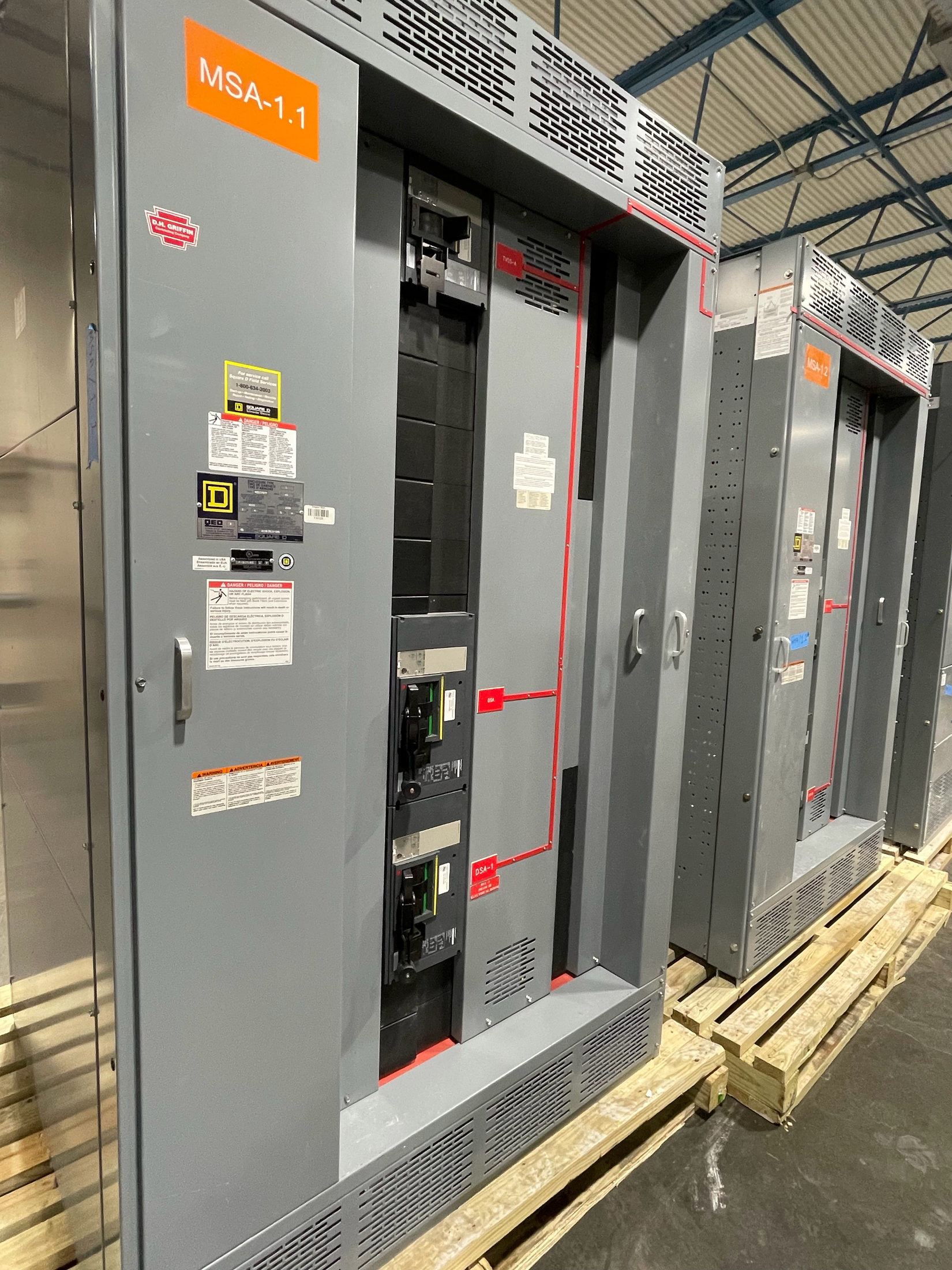
Switchgear Products for Distribution Projects
Switchgear products are not a single interchangeable category. The right equipment depends on how a facility receives, controls, protects and distributes electrical power, as well as the project’s operating requirements. For customers in Austin and across Central Texas, starting with the distribution one-line diagram and equipment specifications helps identify which product family fits the work: a switchboard, a low-voltage switchgear assembly, or equipment designed for a different voltage class or application.
This overview introduces new switchgear and related distribution equipment built in the USA with all-American components. Custom assemblies can be developed to specification, and shipment can be arranged nationwide. Product suitability, applicable standards, lead time and availability are determined through project review; no product category should be assumed suitable based on its name alone.
Switchboards and Low-Voltage Distribution
Switchboards commonly serve as service or distribution equipment in commercial, institutional and industrial systems, subject to the project design and applicable requirements. Their sections may accommodate incoming power, protective devices, metering and outgoing feeders. A switchboard can be a candidate when the project documents call for this type of distribution assembly and its electrical and physical characteristics can be matched to the installation.
UL 891 applies to suitable switchboard assemblies, not automatically to every product or configuration. During selection, confirm the specified voltage, current, short-circuit requirements, incoming arrangement, feeder schedule, neutral and grounding details, and enclosure needs. These are project criteria, not universal product capabilities. Qualified electrical professionals and relevant authorities should review the design and applicable standards before equipment is finalized.
Switchgear for More Demanding Applications
Some projects specify switchgear rather than a switchboard because of system architecture, operating needs, protective-device arrangements or the applicable voltage class. Medium-voltage and high-voltage equipment require distinct engineering and standards considerations; UL 891 should not be treated as a general certification for these categories. Product-family selection begins with the project’s electrical documents and the role the equipment must perform in the distribution system.
Clarify the system voltage class, source and load connections, protection and control functions, operating sequence, installation environment, and interfaces with adjacent equipment. Requirements can vary substantially between projects, so neither a category label nor a prior application establishes suitability. The design team should verify ratings, construction, applicable standards and authority requirements for the specific assembly and its intended use before procurement.
Design Choices That Shape the Assembly
Custom assemblies can be developed around a project specification rather than selected from an assumed standard configuration. Relevant choices may include section arrangement, device and feeder layout, bus requirements, metering and control provisions, cable entry, access clearances and connections to existing or planned equipment. The one-line diagram, equipment schedule and installation drawings provide a practical starting point for resolving these choices.
Site conditions also matter. Confirm the available equipment space, indoor or outdoor placement requirements, environmental conditions, cable routing, working clearances and any constraints on delivery access or movement into position. Enclosure type, ratings and construction must be verified for the actual application. Changes to the design or source documents can affect both suitability and the project schedule, so document assumptions and open questions early.
Coordination, Review and Testing
Switchgear and distribution equipment must coordinate with the wider electrical system. Review protective-device requirements, available fault-current information, upstream and downstream interfaces, grounding, control wiring and the intended operating sequence with the responsible electrical professionals. Confirm that drawings and schedules agree, and identify who will resolve discrepancies. These checks help ensure the proposed assembly addresses the documented application rather than relying on a general product description.
Testing and documentation should be addressed in the project requirements. Confirm what design, production or acceptance checks are specified, what records are expected, and how the equipment will interface with field verification and commissioning activities. The appropriate scope depends on the equipment design and contract documents. Any required approvals or inspections must be determined with the relevant authorities; no listing, approval or test scope should be assumed without confirmation.
Availability and Procurement for Central Texas
For a Central Texas project, procurement planning should connect equipment review with the construction schedule, site readiness and delivery coordination. Share the required-on-site date as a planning target, along with constraints on delivery access, unloading and storage. Shipment can be arranged nationwide, but timing depends on the project’s design, specifications and order details. Lead time and availability should be confirmed for the requested configuration rather than inferred from a product-family description.
To check whether new switchgear can meet project needs, provide the current one-line diagram, specifications, equipment schedules, applicable drawings, site conditions and requested delivery window. Identify whether the design is preliminary or approved for procurement and note any pending decisions. A review can then clarify the appropriate equipment family, missing technical inputs, project-specific options and schedule considerations before the assembly is finalized.
A Practical Path to Product Selection
Begin by identifying the equipment function and voltage class shown in the project documents. Next, compare required ratings, protection, connections, enclosure conditions, dimensions and applicable standards against the proposed design. Ask which items are confirmed, which require engineering review, and which depend on information from the utility, engineer or authority having jurisdiction. This sequence helps distinguish a workable equipment scope from assumptions that could lead to redesign or schedule changes.
When requesting a project review, organize the latest one-line diagram, specification, feeder schedule, equipment location details and procurement milestones in one package. Flag deviations, alternates and unresolved interfaces rather than leaving them implicit. The manufacturer can assess a custom assembly to specification and discuss project-specific availability and lead time. Final selection should follow qualified professional review and confirmation that the design meets the project documents and applicable requirements.
Project specification checklist
Use this checklist to organize the details for a project-specific review. Final ratings, applicable standards and equipment selections depend on the approved design.
| Item | What to confirm |
|---|---|
| Equipment family | Confirm whether the documents call for a switchboard, low-voltage switchgear, or equipment in another voltage class. |
| Electrical requirements | Verify project voltage, current, short-circuit requirements, protective devices and system interfaces. |
| Configuration and site | Confirm section layout, connections, enclosure conditions, dimensions, clearances and delivery access. |
| Standards and review | Identify applicable standards, required documentation, testing scope and authority review for the specific assembly. |
| Procurement timing | Provide the requested delivery window and confirm configuration-specific availability and lead time during project review. |